
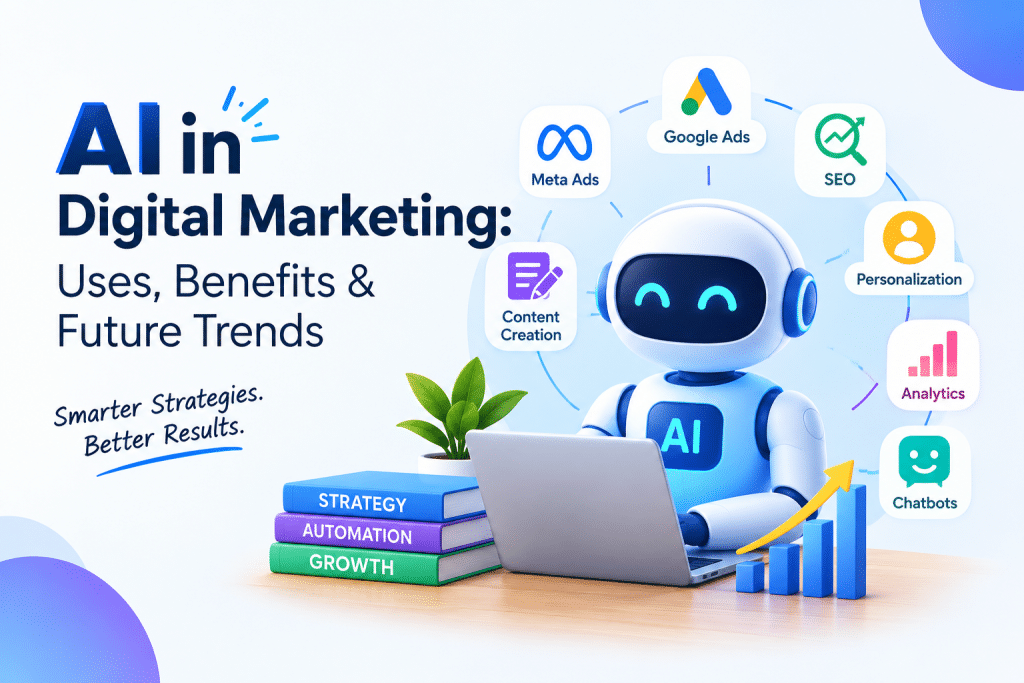
AI in Digital Marketing: How Artificial Intelligence Is Transforming Modern Marketing
Artificial Intelligence (AI) is no longer a futuristic concept—it has become one of the most powerful technologies shaping digital marketing today. From creating personalized content and analyzing customer behavior to optimizing advertising campaigns and improving SEO strategies, AI is helping marketers work faster, smarter, and more efficiently.
But AI isn’t here to replace digital marketers. Instead, it is becoming a powerful partner that helps marketers make better decisions, automate repetitive tasks, understand audiences, and deliver more relevant experiences.
So, how exactly is AI changing digital marketing? Let’s explore.
What Is AI in Digital Marketing?
AI in digital marketing refers to the use of artificial intelligence technologies to analyze data, understand customer behavior, automate marketing activities, generate content, and optimize campaigns.
Traditional digital marketing often requires marketers to manually analyze large amounts of data and make decisions based on available insights.
AI can process huge volumes of information much faster and identify patterns that may be difficult for humans to spot.
For example, AI can help marketers answer questions such as:
- Which audience is most likely to convert?
- Which ad creative is performing best?
- What keywords are potential customers searching for?
- What type of content should be created?
- When is the best time to reach a particular audience?
- Which customers are most likely to make another purchase?
This makes AI a valuable tool for data-driven marketing.
7 Major Uses of AI in Digital Marketing
1. AI-Powered Content Creation
Creating high-quality content consistently is one of the biggest challenges for digital marketers.
AI-powered tools can assist with:
- Blog ideas
- Social media captions
- Ad copy
- Email campaigns
- Product descriptions
- Video scripts
- Content outlines
- Headlines and hooks
- Meta descriptions
For example, instead of spending hours brainstorming 20 social media ideas, a marketer can use AI to generate multiple concepts and then refine the best ones.
However, there is an important difference between AI-generated content and AI-assisted content.
The best results usually come when marketers use AI for research, ideation, and initial drafts while humans provide strategy, brand voice, creativity, fact-checking, and final editing.
AI can generate content. Humans give that content meaning.
2. AI in SEO
Search Engine Optimization has become increasingly data-driven, and AI is changing how marketers approach SEO.
AI can help marketers:
- Discover keyword opportunities
- Analyze search intent
- Generate content ideas
- Build topic clusters
- Identify content gaps
- Optimize titles and descriptions
- Analyze competitors
- Improve internal linking strategies
- Understand user behavior
For example, instead of focusing only on a single keyword such as “digital marketing agency,” marketers can use AI-assisted research to understand related topics and the different questions users have around digital marketing.
This allows marketers to create more comprehensive content instead of producing articles simply to target keywords.
The future of SEO is not just about ranking for keywords.
It is increasingly about answering the right questions for the right audience.
3. AI for Meta Ads and Social Media Advertising
AI is having a major impact on paid social advertising.
Platforms such as Meta use machine learning to analyze signals from users and optimize ad delivery.
Marketers can also use AI to improve different parts of their advertising workflow.
AI can help with:
- Audience research
- Ad copy variations
- Creative concepts
- Campaign analysis
- Performance forecasting
- A/B testing ideas
- Customer segmentation
- Retargeting strategies
- Campaign optimization
For example, a marketer launching a campaign for an online course could create several variations of:
Hook → Primary Text → Headline → CTA → Creative
AI can help generate and organize these variations, while campaign data determines which combinations deserve further testing.
The key is not to let AI make every decision blindly.
The marketer still needs to define the business objective, target audience, offer, positioning, budget, and success metrics.
4. AI in Google Ads
Google Ads involves constant analysis and optimization.
AI and machine learning can help advertisers improve:
- Keyword strategies
- Bidding
- Ad variations
- Audience targeting
- Conversion optimization
- Campaign performance analysis
- Budget allocation
Automated bidding systems can use signals such as device, location, time, user behavior, and other contextual information to optimize bids toward specific goals.
For marketers, this means less time spent on repetitive manual adjustments and more time available for strategy.
However, automation works best when it has quality inputs.
If your conversion tracking, landing page, targeting, or offer is poor, AI cannot magically turn a weak campaign into a profitable one.
Better data + better strategy + better automation = better marketing performance.
5. AI-Powered Personalization
Imagine visiting an e-commerce website and seeing products that match your interests rather than random products.
That is personalization.
AI can analyze customer behavior such as:
- Pages visited
- Products viewed
- Previous purchases
- Search behavior
- Engagement history
- Location
- Preferences
Based on these signals, businesses can create more personalized experiences.
For example:
A customer who repeatedly views running shoes could receive content or offers related to running products instead of generic sports products.
Personalization can make marketing more relevant and reduce the feeling of receiving irrelevant promotional messages.
6. AI Chatbots and Customer Engagement
Customer expectations have changed.
People increasingly want quick answers rather than waiting hours or days for a response.
AI-powered chatbots can help businesses answer common questions 24/7.
They can assist with:
- Product information
- Pricing questions
- Appointment booking
- Lead qualification
- Frequently asked questions
- Order updates
- Basic customer support
For example, a digital marketing agency could use an AI chatbot to ask a website visitor:
“What service are you interested in?”
The chatbot could then collect information about the visitor’s business, marketing goals, budget, and requirements before passing qualified leads to the sales team.
This can improve both response time and lead management.
7. AI-Powered Data Analytics
Digital marketing produces enormous amounts of data.
Think about the information generated from:
- Website visitors
- Google Ads
- Meta Ads
- Search Console
- CRM systems
- Email campaigns
- E-commerce platforms
The challenge isn’t simply collecting data.
The real challenge is understanding what the data means.
AI can help identify patterns, trends, anomalies, and potential opportunities.
For example, instead of simply looking at:
2,000 website visitors
a marketer wants to know:
“Which visitors are most likely to become customers?”
AI-powered analytics can help marketers move from basic reporting toward predictive insights.
AI in Digital Marketing: Traditional Marketing vs AI-Assisted Marketing
| Traditional Approach | AI-Assisted Approach |
|---|---|
| Manual data analysis | Automated pattern detection |
| Manual audience research | AI-assisted audience insights |
| Content created from scratch | AI-assisted content ideation |
| Manual campaign optimization | Automated optimization |
| Generic messaging | Personalized messaging |
| Reactive reporting | Predictive insights |
| Time-consuming repetitive tasks | Automated workflows |
AI doesn’t necessarily replace the traditional marketing process.
Instead, it can make many parts of the process faster and more data-driven.
Benefits of Using AI in Digital Marketing
Faster Content Production
AI can dramatically reduce the time required for brainstorming, outlining, and drafting content.
Better Data Analysis
AI can process large datasets and identify patterns more efficiently than manual analysis.
Improved Personalization
Businesses can create more relevant experiences based on customer behavior.
Marketing Automation
Repetitive activities can be automated, allowing marketers to focus on higher-value tasks.
Better Decision-Making
AI can provide insights that support data-driven marketing decisions.
Improved Customer Experience
Chatbots and intelligent recommendation systems can provide faster and more relevant interactions.
Greater Scalability
AI allows small marketing teams to handle tasks that previously required significantly more time and resources.
The Challenges of Using AI in Digital Marketing
AI has enormous potential, but it isn’t perfect.
There are several challenges marketers need to consider.
1. Lack of Human Creativity
AI can generate ideas, but it may struggle to understand the emotional nuances of a brand or audience.
2. Accuracy Issues
AI-generated information can sometimes be incorrect or outdated.
Every important piece of content should be reviewed and fact-checked.
3. Generic Content
If marketers rely completely on AI-generated content without adding original insights, the result can feel repetitive and generic.
4. Data Privacy
Businesses must handle customer data responsibly and comply with applicable privacy requirements.
5. Over-Automation
Automation is useful, but not every marketing decision should be handed over to a machine.
Marketing still requires human judgment.
AI Won’t Replace Digital Marketers—But Digital Marketers Using AI May Have an Advantage
This is one of the biggest misconceptions surrounding AI.
The future isn’t necessarily:
AI vs Digital Marketer
It is more likely:
AI + Digital Marketer
A marketer understands:
- Brand positioning
- Customer psychology
- Business objectives
- Creative strategy
- Communication
- Market trends
- Human emotions
AI brings:
- Speed
- Automation
- Data processing
- Pattern recognition
- Scalability
- Predictive capabilities
When these strengths are combined, marketers can potentially produce better results with less repetitive effort.
How Businesses Can Start Using AI in Digital Marketing
You don’t need to implement dozens of AI tools immediately.
Start with practical use cases.
Step 1: Identify Repetitive Tasks
Find activities that consume significant time but don’t require constant human creativity.
Step 2: Start With One Marketing Channel
For example, begin with:
SEO → Content → Meta Ads → Google Ads → Analytics
Step 3: Use AI for Research and Ideation
Use AI to brainstorm ideas, analyze information, and identify opportunities.
Step 4: Keep Humans in the Loop
Review AI-generated content, recommendations, and insights before publishing or implementing them.
Step 5: Measure Results
Track metrics such as:
- Leads
- Cost per lead
- Conversion rate
- Return on ad spend
- Website traffic
- Engagement
- Customer acquisition cost
AI should ultimately contribute to business outcomes, not simply produce more content.
The Future of AI in Digital Marketing
The role of AI in marketing is likely to become even more significant.
We can expect greater use of AI for:
- Predictive customer behavior
- Automated campaign optimization
- Hyper-personalized marketing
- AI-powered search experiences
- Conversational marketing
- Automated content workflows
- Predictive lead scoring
- Real-time customer insights
But one thing is unlikely to change:
People still buy from brands they trust.
Technology can help businesses understand customers and communicate more efficiently, but trust, creativity, empathy, positioning, and strong offers remain fundamental to successful marketing.
Final Thoughts
AI is changing digital marketing from a largely manual and reactive process into a more automated, personalized, and data-driven discipline.
From SEO and content creation to Meta Ads, Google Ads, analytics, personalization, and customer engagement, AI can help marketers save time and make smarter decisions.
But AI should not be treated as a replacement for marketing strategy.
The strongest approach is to combine artificial intelligence with human intelligence.
Use AI for speed.
Use data for decisions.
Use creativity for differentiation.
And use human understanding to build genuine connections with your audience.
The future of digital marketing isn’t about choosing between AI and humans. It’s about learning how to make them work better together.
Ready to Make AI Work for Your Marketing?
Whether you’re looking to improve your Meta Ads, Google Ads, SEO, content strategy, or overall digital presence, the right combination of technology and marketing strategy can help your business reach the right audience and generate better opportunities.
Don’t just follow the AI revolution. Learn how to use it strategically.
What Is AI in Digital Marketing?
AI in digital marketing refers to the use of artificial intelligence technologies to analyze data, understand customer behavior, automate marketing activities, generate content, and optimize campaigns.
Traditional digital marketing often requires marketers to manually analyze large amounts of data and make decisions based on available insights.
AI can process huge volumes of information much faster and identify patterns that may be difficult for humans to spot.
For example, AI can help marketers answer questions such as:
- Which audience is most likely to convert?
- Which ad creative is performing best?
- What keywords are potential customers searching for?
- What type of content should be created?
- When is the best time to reach a particular audience?
- Which customers are most likely to make another purchase?
This makes AI a valuable tool for data-driven marketing.
AI-Powered Content Creation
Creating high-quality content consistently is one of the biggest challenges for digital marketers.
AI-powered tools can assist with:
- Blog ideas
- Social media captions
- Ad copy
- Email campaigns
- Product descriptions
- Video scripts
- Content outlines
- Headlines and hooks
- Meta descriptions
For example, instead of spending hours brainstorming 20 social media ideas, a marketer can use AI to generate multiple concepts and then refine the best ones.
However, there is an important difference between AI-generated content and AI-assisted content.
The best results usually come when marketers use AI for research, ideation, and initial drafts while humans provide strategy, brand voice, creativity, fact-checking, and final editing.
AI can generate content. Humans give that content meaning.